HORA: 18:30 H.
MAPA
http://maps.google.es/maps/ms?hl=es&ie=UTF8&msa=0&ll=42.044576,3.174362&spn=0.030213,0.058022&z=14&msid=101086978984742966175.00044de1d0a5a1c29d3ae
Per mirar el mapa, utilitzeu l'eina del zoom. Si cliqueu a cadascuna de les indicacions de mà esquerra, les veureu senyalades en el mapa.
Heu de buscar el rètol "Urbanització La platera". Si passeu per davant d'un parc infantil, vol dir que us l'heu passat de llarg.
Apa! esperem que ho trobeu!
Una abraçada,
Karl i Mireia
28 de maig 2008


Què posar-se? / Dress code by Vogue
http://www.voguenovias.com/index.php/mod.noticias/mem.detalle/idnoticia.68676/relcategoria.2508/chk.406cf4ebe56c85e9dc776a9c7bd1c592.html
La perfecta invitada 'The perfect guest' according to Vogue
Elegir un vestido para una boda no es nada sencillo, nosotros te ayudamos. Además de estar radiante el día de su boda, toda novia quiere que sus invitadas estén también perfectas. Sin embargo, no es fácil elegir el vestido adecuado para un evento de este tipo. Nosotros te proponemos las tendencias y los vestidos más adecuados para la ocasión. Toma nota y olvídate de la típica frase de desesperación: “¿qué me pongo?” 'What should I dress?' El primer paso para ser la perfecta invitada es elegir el traje según la hora del enlace. To select the dress depending on the hour of the wedding. Si es por la mañana nunca te decantes por un traje largo y huye de los tonos noche como los azules y metalizados propios de fiesta. If the wedding is in the morning: never dress black, dark blue or metal colours. Inclínate por los colores pastel pero recuerda, no elijas ningún vestido en cualquiera de las opciones que ofrece el blanco, ese es exclusivo de la novia y nadie debe hacerle sombra (pale colours are suitable, except white). Por el contrario, si la celebración es por la noche puedes jugar con varios tipos de largo y permitirte tanto el negro como los tonos propios de fiesta, e incluso te animamos a que los combines con colores energy para darle más fuerza a tu look. At night, black colour is suitable as well as 'night party' colours and also strong colours. Aunque estés deseando lucir tu vestido tendrás que esperar a la celebración para hacerlo. Si te decantas por un escote muy sugerente o un modelo palabra de honor deberás taparte durante la ceremonia. Nuestro consejo es que te decantes por boleros o chaquetas tipo torera, y para los días más fríos nada mejor que un abriguito en tonos neutros. If you show a lot of cliverage, it's advisable to cover it with something (jaquet, pashmina, foulard, etc.) En cuanto a los complementos, te proponemos las carteras de mano, pero no las busques del mismo tono que el vestido, al contrario, rompe un poco la homogeneidad con algún color complementario. Look for a handbag, preferable it shouldn't be the same colour as the dress. Tanto de día como de noche y aunque te parezca una tortura deberás siempre llevar zapatos con tacón Of course, you should wear heals. Un consejo, si eres de las que no los aguantan cómprate unos zapatos con un poco de plataforma, además de ir a la moda, te sentirás mucho más cómoda. Por Susana Molina.
La perfecta invitada 'The perfect guest' according to Vogue
Elegir un vestido para una boda no es nada sencillo, nosotros te ayudamos. Además de estar radiante el día de su boda, toda novia quiere que sus invitadas estén también perfectas. Sin embargo, no es fácil elegir el vestido adecuado para un evento de este tipo. Nosotros te proponemos las tendencias y los vestidos más adecuados para la ocasión. Toma nota y olvídate de la típica frase de desesperación: “¿qué me pongo?” 'What should I dress?' El primer paso para ser la perfecta invitada es elegir el traje según la hora del enlace. To select the dress depending on the hour of the wedding. Si es por la mañana nunca te decantes por un traje largo y huye de los tonos noche como los azules y metalizados propios de fiesta. If the wedding is in the morning: never dress black, dark blue or metal colours. Inclínate por los colores pastel pero recuerda, no elijas ningún vestido en cualquiera de las opciones que ofrece el blanco, ese es exclusivo de la novia y nadie debe hacerle sombra (pale colours are suitable, except white). Por el contrario, si la celebración es por la noche puedes jugar con varios tipos de largo y permitirte tanto el negro como los tonos propios de fiesta, e incluso te animamos a que los combines con colores energy para darle más fuerza a tu look. At night, black colour is suitable as well as 'night party' colours and also strong colours. Aunque estés deseando lucir tu vestido tendrás que esperar a la celebración para hacerlo. Si te decantas por un escote muy sugerente o un modelo palabra de honor deberás taparte durante la ceremonia. Nuestro consejo es que te decantes por boleros o chaquetas tipo torera, y para los días más fríos nada mejor que un abriguito en tonos neutros. If you show a lot of cliverage, it's advisable to cover it with something (jaquet, pashmina, foulard, etc.) En cuanto a los complementos, te proponemos las carteras de mano, pero no las busques del mismo tono que el vestido, al contrario, rompe un poco la homogeneidad con algún color complementario. Look for a handbag, preferable it shouldn't be the same colour as the dress. Tanto de día como de noche y aunque te parezca una tortura deberás siempre llevar zapatos con tacón Of course, you should wear heals. Un consejo, si eres de las que no los aguantan cómprate unos zapatos con un poco de plataforma, además de ir a la moda, te sentirás mucho más cómoda. Por Susana Molina.
4 d’abr. 2008
D'on són les curculles i els cargolins de la invitació? Where are the seashells from?
Tot i que les podíem haver comprat, no són del supermercat. Són les que el mar de les terres australianes va deixar abandonades a la sorra. Les vam recollir el Nadal passat quan vam anar uns dies a la platja. I van viatjar amb nosaltres fins al Canadà per després tornar a volar fins arribar a les vostres mans. Després de fer quants quilòmetres i passar unes quantes aduanes estem contents de saber que heu rebut la invitació!
Although we could have bought the seashells, they are not from the supermarket. The are the ones that the Australian sea left abandoned on the sand. We collected them last Christmas when we went to the beach. And they travelled with us to Canada for flying again to reach your hands. After doing several km and pass some custom controls, we are happy to know that you have received the invitate!
Although we could have bought the seashells, they are not from the supermarket. The are the ones that the Australian sea left abandoned on the sand. We collected them last Christmas when we went to the beach. And they travelled with us to Canada for flying again to reach your hands. After doing several km and pass some custom controls, we are happy to know that you have received the invitate!
13 de març 2008
About Figueres and the Alt Empordà
Nothing describes the charm of this region better than recalling that the Alt Empordà is the land that captivated Salvador Dalí and contains two of the three vertices of the so-called Dali Triangle consisting of the museum and the houses where he lived a large part of his life. In this region marked by the proximity of the sea and the Pyrenees, visits to the following sites are well worth anyones while: the Cap de Creus Natural Park, the Greek and Roman ruins of Empúries and the medieval town of Sant Marti d'Empuries, the marshes of the Aiguamolls de I'Emporda Natural Park, Cadaques and Sant Pere de Rodes.The region is situated at the north-eastern most corner of the Iberian peninsula, where the Costa Brava begins, with small coastal towns like Portbou and Colera.
The capital, Figueres, is known world-wide for being the site of the Dali Theatre Museum, one of Spain's most frequently visited museums, which houses a great deal of the painter's works. From here, one can embark on a journey covering the life of Salvador Dalí, including a visit to the Pubol castle (in the Baix Emporda region) and to his home in Portlligat, in Cadaques. Other interesting attractions in Figueres include the Catalonia Toy Museum, which displays all kinds of miniature toys made by the world's most prestigious toymakers, the Empordà Museum, whose collection ranges from archaeological finds from Empúries and Ullastret to 20th-century paintings by Vayreda, Tapies or Cuixart.
The Alt Emporda region also boasts natural areas of great environmental interest. The Aiguamolls de I'Emporda Natural Park, situated between the towns of Castelló d'Empuries, Empuriabrava (a residential area that provides a wide range of leisure offerings and where the Mediterranean's biggest residential marina is located) and Sant Pere Pescador, concentrates a large number of autochthonous flora and fauna species. The Cap de Creus Natural Park, which occupies a surface area of 10,787 hectares on land and another 3,073 hectares of sea, encompasses the coastal towns of Cadaques, El Port de la Selva, Llanca and Roses, and the inland towns of La Selva de Mar, Palau -saverdera, Pau and Vilajuiga. Another area worthy of mention is the Albera range, which comprises the municipalities of La Jonquera, Rabós d'Emporda, Espolla, Cantallops, Vilamaniscle, Garriguella, Mollet de Peralada and Sant Climent Sescebes, and the Salines-Bassegoda area, which includes the townships of Agullana, Albanya, Darnius (with the Boadella reservoir), Sant Llorenc de la Muga, Macanet de Cabrenys and La Vajol. The charm of these towns is completed by one of Catalonia's most important concentrations of megalithic monuments and by a good number of small Romanesque churches, both of which make the Alt Emporda one of the richest regions of Girona in terms of natural, monumental and historical heritage.
Considered among the most important archaeological sites of the Iberian Peninsula in terms of the Greek and Roman colonization periods, the ruins of Empúries, located in the maritime village of L'Escala, constitute one of the region's most prized treasures. Very near the remains of the Greek and Roman settlements is the medieval town of Sant Marti d'Empuries, with houses that combine the Gothic style with architectural elements from successive cultures. In addition to its magnificent leisure and vacation facilities, the town of Roses is well known for its citadel. The site preserves the remains of the different occupations that the town has sustained since the Greeks founded it in the 5th century B.C. until the enclosure was abandoned in the 19th century A.D. Diggings at the site have unturned the Hellenic district, the Roman village, and the medieval monastery of Santa Maria, not to mention the citadel itself, a fortification dating back to the Renaissance which was partially destroyed during the Napoleonic Wars.
The historic enclosure of Peralada castle constitutes another undisputed point of interest, foremost of which is the architectural magnificence of the castle of the lords of Rocaberti and the Carmelite convent, built in the 12th century. The castle houses a museum with important collections of pottery, glass and other works of ancient art, and includes a library with over 70,000 volumes It also doubles as a prestigious gambling casino and hosts an International Music Festival.The Alt Emporda region also boasts a grand legacy composed of Romanesque monuments. The architectural complex of Sant Pere de Rodes, declared a World Heritage site by the UNESCO, is formed by a Benedictine monastery that, like the church, dates from the 1Oth century, as well as a belfry and defensive tower that were added on in the 12th century. The collegiate church of Santa Maria de Vilabertran consists of three elements: the church, that dates from the 11th-12th centuries, and the cloister and the abbatial palace, both built in the 12th century. The Sant Quirze de Colera monastery comprises the church, built in the 9th century, the remains of a Pre-Romanesque cloister, and the buildings of the ancient abbey, dating from the 9th-15th centuries. Other sites that deserve the visitor's attention are the beautiful Augustinian monastery of Santa Maria de Llado and the church of Sant Miquel de Fluvia a building that dates from the 11th century and constitutes one of the best-preserved samples of the earliest Romanesque style.
The presence of the Gothic style in the region is well- illustrated by the church of Santa Maria in Castello d'Empuries, also known as the "Emporda cathedral" due to the influence it wielded during the Middle Ages. The temple, which dates back to the 14th century, is characterised by its magnificent bell tower.
The scenery of this region, determined by the contrast between the sea, the plains and the mountains, is complemented as well by extensive vineyards that produce excellent cava and wines.
Source: http://www.pyreneesguide.com/articles.asp?cID=51&sID=249&aID=201
The capital, Figueres, is known world-wide for being the site of the Dali Theatre Museum, one of Spain's most frequently visited museums, which houses a great deal of the painter's works. From here, one can embark on a journey covering the life of Salvador Dalí, including a visit to the Pubol castle (in the Baix Emporda region) and to his home in Portlligat, in Cadaques. Other interesting attractions in Figueres include the Catalonia Toy Museum, which displays all kinds of miniature toys made by the world's most prestigious toymakers, the Empordà Museum, whose collection ranges from archaeological finds from Empúries and Ullastret to 20th-century paintings by Vayreda, Tapies or Cuixart.
The Alt Emporda region also boasts natural areas of great environmental interest. The Aiguamolls de I'Emporda Natural Park, situated between the towns of Castelló d'Empuries, Empuriabrava (a residential area that provides a wide range of leisure offerings and where the Mediterranean's biggest residential marina is located) and Sant Pere Pescador, concentrates a large number of autochthonous flora and fauna species. The Cap de Creus Natural Park, which occupies a surface area of 10,787 hectares on land and another 3,073 hectares of sea, encompasses the coastal towns of Cadaques, El Port de la Selva, Llanca and Roses, and the inland towns of La Selva de Mar, Palau -saverdera, Pau and Vilajuiga. Another area worthy of mention is the Albera range, which comprises the municipalities of La Jonquera, Rabós d'Emporda, Espolla, Cantallops, Vilamaniscle, Garriguella, Mollet de Peralada and Sant Climent Sescebes, and the Salines-Bassegoda area, which includes the townships of Agullana, Albanya, Darnius (with the Boadella reservoir), Sant Llorenc de la Muga, Macanet de Cabrenys and La Vajol. The charm of these towns is completed by one of Catalonia's most important concentrations of megalithic monuments and by a good number of small Romanesque churches, both of which make the Alt Emporda one of the richest regions of Girona in terms of natural, monumental and historical heritage.
Considered among the most important archaeological sites of the Iberian Peninsula in terms of the Greek and Roman colonization periods, the ruins of Empúries, located in the maritime village of L'Escala, constitute one of the region's most prized treasures. Very near the remains of the Greek and Roman settlements is the medieval town of Sant Marti d'Empuries, with houses that combine the Gothic style with architectural elements from successive cultures. In addition to its magnificent leisure and vacation facilities, the town of Roses is well known for its citadel. The site preserves the remains of the different occupations that the town has sustained since the Greeks founded it in the 5th century B.C. until the enclosure was abandoned in the 19th century A.D. Diggings at the site have unturned the Hellenic district, the Roman village, and the medieval monastery of Santa Maria, not to mention the citadel itself, a fortification dating back to the Renaissance which was partially destroyed during the Napoleonic Wars.
The historic enclosure of Peralada castle constitutes another undisputed point of interest, foremost of which is the architectural magnificence of the castle of the lords of Rocaberti and the Carmelite convent, built in the 12th century. The castle houses a museum with important collections of pottery, glass and other works of ancient art, and includes a library with over 70,000 volumes It also doubles as a prestigious gambling casino and hosts an International Music Festival.The Alt Emporda region also boasts a grand legacy composed of Romanesque monuments. The architectural complex of Sant Pere de Rodes, declared a World Heritage site by the UNESCO, is formed by a Benedictine monastery that, like the church, dates from the 1Oth century, as well as a belfry and defensive tower that were added on in the 12th century. The collegiate church of Santa Maria de Vilabertran consists of three elements: the church, that dates from the 11th-12th centuries, and the cloister and the abbatial palace, both built in the 12th century. The Sant Quirze de Colera monastery comprises the church, built in the 9th century, the remains of a Pre-Romanesque cloister, and the buildings of the ancient abbey, dating from the 9th-15th centuries. Other sites that deserve the visitor's attention are the beautiful Augustinian monastery of Santa Maria de Llado and the church of Sant Miquel de Fluvia a building that dates from the 11th century and constitutes one of the best-preserved samples of the earliest Romanesque style.
The presence of the Gothic style in the region is well- illustrated by the church of Santa Maria in Castello d'Empuries, also known as the "Emporda cathedral" due to the influence it wielded during the Middle Ages. The temple, which dates back to the 14th century, is characterised by its magnificent bell tower.
The scenery of this region, determined by the contrast between the sea, the plains and the mountains, is complemented as well by extensive vineyards that produce excellent cava and wines.
Source: http://www.pyreneesguide.com/articles.asp?cID=51&sID=249&aID=201
9 de març 2008
Let us know when you arrive
Hello all,
Let us know when you arrive to help you to find a place to stay in Barcelona.
Do you also plan to visit other places of Catalonia and Spain? if yes, we can give you a hand looking for information for you and planning your trip.
What do you need? tell us and we will be very pleased to help you.
Karl and Mireia
Let us know when you arrive to help you to find a place to stay in Barcelona.
Do you also plan to visit other places of Catalonia and Spain? if yes, we can give you a hand looking for information for you and planning your trip.
What do you need? tell us and we will be very pleased to help you.
Karl and Mireia
23 de febr. 2008
Welcome to Catalonia!!!
Catalonia is a small country of six million inhabitants but it has more than a thousand years of history and a culture and language of its own which have forged a very distinct character. Today Catalonia is one of the most prosperous regions of Spain, it is an Autonomous Community within Spain an occupies an area of 31,930 square kilometers. The capital of Catalonia is Barcelona.
The people of Catalonia have always been open to the outside world. We love to welcome foreigners and show them our homeland. And we like them to feel at home among us. Mediterranean beaches, there are places of artistic interest, historic buildings and landscapes which are equally well worth seeing.
As you travel around Catalonia, you will discover every kind of European vegetation and landscape:
- High mountain scenery in the Pyrinees: i.e. Two spectacular National Parks: "Aigüestortes and Lake Sant Maurici", and "Cadí-Moixeró". Take also advantatge of visiting the little villages of "the La Vall d'Aran" and "the Alta Ribagorça" like Boí-Taüll, where there is one of the most beautiful little churches of the early romanesc art.
- Moderate altitudes: i.e. "Park of the Muntanya de Montserrat", with its fascinating geological formations, or explore "the Garrotxa Volcanic Zone Park", near Olot, to see the tree clad hollows of extinct volcanoes, or "the Montseny range", which has been declared a reserve of the biosphere by UNESCO on account of is rich plant life.
- Southerly mountains: i.e. "the Garraf range" with bare rocks and gray and reddish soil which create a very striking atmoshpher. This is the home of the dwarf fan-palm, the only palm native to Europe. Or, "the Ports of Tortosa", overlooking the "Ebre Delta", is an important reserve of the Spanish ibex goat.
Take a good look at our traditional farmhouses or "masies", each of which was once a thriving community in its own right, and notice how the farmers have adopted modern agricultural methods without losing their sense of tradition. You will see that the Catalan countryside's a perfect blend of nature and human skill.
Catalonia also offers a wide range of coastal scenery:
- "The Costa Brava" (the "Rugged Coast"): you will be entranced by the rocks reaching out into the sea, the secluded coves and islands where the pine-tree roots struggle for a foothold right down to the water's edge.
- "The Costa del Maresme" and "Costa Daurada" : long sun-drenched beaches and white fishermen's cottages welcome you to a typically Mediterranean environment, on the shores of a friendly sea that has been known to man since ancient times.
- "The vast wetlands of the Ebre delta" : here reedy marshes provide an ideal refuge for migrating birds and the area is one of the largest bird sanctuaries in Europe.
Places with a history background:
- Greek, Roman and Iberian remains / ruins: "Empúries" , on the Costa Brava, offers the atmosphere of classical Greece. The Greek colonizers, and their Roman successors, left behind a rich collection of sculptures and ceramics here. And just a short distance away is "the iberian settlement of Ullastret" where you can stroll in the shadow of ancient towering walls. Also, on the Costa Daurada, you can visit "the Roman city of Tarraco" , present-day "Tarragona" , with its wealth of Roman remains.
- Medieval scene: as the personality of Catalonia was formed in the Middle Ages, you will find ancient buildings dating from the 9th to the 14th century in pre-Romanesque and Gothic style. Among the most remarkable are "the monastery of Sant Pere de Rodes", overlooking the sea on the Costa Brava, and farther inland "the monastery of Santa Maria de Ripoll" and "the three Cistercian monasteries of Santa Maria de Poblet, Santes Creus and Vallbona de les Monges", all important centres of culture and art in the Middle Ages.
- Magnificient cathedrals: in the cities of Girona, Vic, Barcelona, Tarragona, Tortosa and Lleida. "Girona cathedral" is famous for its single nave - the widest Gothic nave in Europe. Other handsome medieval buildings are the current, or former, homes of government institutions. Examples are "the Paeria" in Lleida and "the Palace of the Generalitat" in Barcelona, which is the seat of the present-day Catalan government. All these ancient stones will tell you tales of days gone by when Catalan merchants sailed all over the Mediterranean and catalan men-of-arms controlled many places around its shores.
- Modernist style: it's the characteristically Catalan version of Art Nouveau which was all the vogue in Europe. You can see modernist-style wine cellars -also known as "wine cathedrals"-, built in the rural areas, i.e. "Cavas Freixenet". Also, you will be able to discover the Modernist-style factories which bear witness to the industrial strength of Catalonia in the wake of the Industrial Revolution, i.e. "Colonia Güell" of Antoni Gaudí. Barcelona has more Art Nouveau buildings than any other city in the world, i.e. "Sagrada Família", "Casa Batlló", "La Pedrera", "El Palau de la Música", "El Palau Güell", etc. Today the innovative tradition of Catalan architecture remains very much alive.
Do not miss to visit the famous villages of the Catalan coast:
- "Cadaqués": a small town situated on the Mediterranean Sea, just a few miles from the French border. It is a picturesque and artsy village. The rough seashore north of Cadaques Catalonia provides dramatic seascapes for photographers and hikers. Salvador Dali, the famous painter of Surrealism, spent much of his life in Cadaques, where he had a house that it is able to visit.
- "Roses": the village itself is less picturesque than other Costa Brava villages. But it's worth seen because it's place in a bay with stunning views. Explore the beaches up north to Roses: "Canyelles petites" , "l'Almadraba" , as well as the Capes "Punta Falconera" and "Cap de Creus". There are several hiking routes around the area.
- "Begur": it is a very nice tiny village, famous for its coves. It has a medieval castle overlooking the town.
- "Tossa de Mar": located on the South of the Costa Brava, it is one of the villages of the Costa Brava that has preserved better its character. It has a pretty castle, narrow streets, etc.
- "Sitges": situated in the "Massif of Garraf" and only at 35km in the South of Barcelona, it's very easy to commute by local train from Barcelona. Sitges has preserved a very beautiful historical quarter with some Middle Age references.
Inland, we highly recommend to stop to:
- "Girona": it is a very beautiful town situated in the North of Catalonia. It has important historical monuments / attractions such as the walls, the mediaval quarter as well as the jewish one, "El Call", or the Arab baths.
Catalan museums:
Catalonia, small as it is, has a surprisingly large number of museums - over 300-, some with valuable collections of world-wide interest. This is just a small selection:
In Barcelona:
- "The National Museum of Art of Catalonia", on Montjuïc hill, you can admire the finest collection of Romanesque paintings in the world. Also on Montjuïc there is the Joan Miró Foundation, a highly distinctive building which houses some remarkable examples of Miro’s work. "The Museum of Modern Art", in the Ciutadella Park, contains a fine collection of 19th and 20th century Catalan paintings and sculptures. "The Barcelona Museum of Contemporary Art", inaugurated in 1995, occupies a striking building by Richard Meier in the heart of the Raval district. The Picasso Museum, in a handsome, well restored Gothic palace on Carrer Montcada, contains interesting works by the young Picasso, as well as items from other periods donated by the artist himself.
In Figueres:
- "Salvador Dalí Museum", the finest of the Surrealist master. It's the place of the originality and extravagance.
Source: http://www.gencat.net/turistex_nou/home_ang.htm
The people of Catalonia have always been open to the outside world. We love to welcome foreigners and show them our homeland. And we like them to feel at home among us. Mediterranean beaches, there are places of artistic interest, historic buildings and landscapes which are equally well worth seeing.
As you travel around Catalonia, you will discover every kind of European vegetation and landscape:
- High mountain scenery in the Pyrinees: i.e. Two spectacular National Parks: "Aigüestortes and Lake Sant Maurici", and "Cadí-Moixeró". Take also advantatge of visiting the little villages of "the La Vall d'Aran" and "the Alta Ribagorça" like Boí-Taüll, where there is one of the most beautiful little churches of the early romanesc art.
- Moderate altitudes: i.e. "Park of the Muntanya de Montserrat", with its fascinating geological formations, or explore "the Garrotxa Volcanic Zone Park", near Olot, to see the tree clad hollows of extinct volcanoes, or "the Montseny range", which has been declared a reserve of the biosphere by UNESCO on account of is rich plant life.
- Southerly mountains: i.e. "the Garraf range" with bare rocks and gray and reddish soil which create a very striking atmoshpher. This is the home of the dwarf fan-palm, the only palm native to Europe. Or, "the Ports of Tortosa", overlooking the "Ebre Delta", is an important reserve of the Spanish ibex goat.
Take a good look at our traditional farmhouses or "masies", each of which was once a thriving community in its own right, and notice how the farmers have adopted modern agricultural methods without losing their sense of tradition. You will see that the Catalan countryside's a perfect blend of nature and human skill.
Catalonia also offers a wide range of coastal scenery:
- "The Costa Brava" (the "Rugged Coast"): you will be entranced by the rocks reaching out into the sea, the secluded coves and islands where the pine-tree roots struggle for a foothold right down to the water's edge.
- "The Costa del Maresme" and "Costa Daurada" : long sun-drenched beaches and white fishermen's cottages welcome you to a typically Mediterranean environment, on the shores of a friendly sea that has been known to man since ancient times.
- "The vast wetlands of the Ebre delta" : here reedy marshes provide an ideal refuge for migrating birds and the area is one of the largest bird sanctuaries in Europe.
Places with a history background:
- Greek, Roman and Iberian remains / ruins: "Empúries" , on the Costa Brava, offers the atmosphere of classical Greece. The Greek colonizers, and their Roman successors, left behind a rich collection of sculptures and ceramics here. And just a short distance away is "the iberian settlement of Ullastret" where you can stroll in the shadow of ancient towering walls. Also, on the Costa Daurada, you can visit "the Roman city of Tarraco" , present-day "Tarragona" , with its wealth of Roman remains.
- Medieval scene: as the personality of Catalonia was formed in the Middle Ages, you will find ancient buildings dating from the 9th to the 14th century in pre-Romanesque and Gothic style. Among the most remarkable are "the monastery of Sant Pere de Rodes", overlooking the sea on the Costa Brava, and farther inland "the monastery of Santa Maria de Ripoll" and "the three Cistercian monasteries of Santa Maria de Poblet, Santes Creus and Vallbona de les Monges", all important centres of culture and art in the Middle Ages.
- Magnificient cathedrals: in the cities of Girona, Vic, Barcelona, Tarragona, Tortosa and Lleida. "Girona cathedral" is famous for its single nave - the widest Gothic nave in Europe. Other handsome medieval buildings are the current, or former, homes of government institutions. Examples are "the Paeria" in Lleida and "the Palace of the Generalitat" in Barcelona, which is the seat of the present-day Catalan government. All these ancient stones will tell you tales of days gone by when Catalan merchants sailed all over the Mediterranean and catalan men-of-arms controlled many places around its shores.
- Modernist style: it's the characteristically Catalan version of Art Nouveau which was all the vogue in Europe. You can see modernist-style wine cellars -also known as "wine cathedrals"-, built in the rural areas, i.e. "Cavas Freixenet". Also, you will be able to discover the Modernist-style factories which bear witness to the industrial strength of Catalonia in the wake of the Industrial Revolution, i.e. "Colonia Güell" of Antoni Gaudí. Barcelona has more Art Nouveau buildings than any other city in the world, i.e. "Sagrada Família", "Casa Batlló", "La Pedrera", "El Palau de la Música", "El Palau Güell", etc. Today the innovative tradition of Catalan architecture remains very much alive.
Do not miss to visit the famous villages of the Catalan coast:
- "Cadaqués": a small town situated on the Mediterranean Sea, just a few miles from the French border. It is a picturesque and artsy village. The rough seashore north of Cadaques Catalonia provides dramatic seascapes for photographers and hikers. Salvador Dali, the famous painter of Surrealism, spent much of his life in Cadaques, where he had a house that it is able to visit.
- "Roses": the village itself is less picturesque than other Costa Brava villages. But it's worth seen because it's place in a bay with stunning views. Explore the beaches up north to Roses: "Canyelles petites" , "l'Almadraba" , as well as the Capes "Punta Falconera" and "Cap de Creus". There are several hiking routes around the area.
- "Begur": it is a very nice tiny village, famous for its coves. It has a medieval castle overlooking the town.
- "Tossa de Mar": located on the South of the Costa Brava, it is one of the villages of the Costa Brava that has preserved better its character. It has a pretty castle, narrow streets, etc.
- "Sitges": situated in the "Massif of Garraf" and only at 35km in the South of Barcelona, it's very easy to commute by local train from Barcelona. Sitges has preserved a very beautiful historical quarter with some Middle Age references.
Inland, we highly recommend to stop to:
- "Girona": it is a very beautiful town situated in the North of Catalonia. It has important historical monuments / attractions such as the walls, the mediaval quarter as well as the jewish one, "El Call", or the Arab baths.
Catalan museums:
Catalonia, small as it is, has a surprisingly large number of museums - over 300-, some with valuable collections of world-wide interest. This is just a small selection:
In Barcelona:
- "The National Museum of Art of Catalonia", on Montjuïc hill, you can admire the finest collection of Romanesque paintings in the world. Also on Montjuïc there is the Joan Miró Foundation, a highly distinctive building which houses some remarkable examples of Miro’s work. "The Museum of Modern Art", in the Ciutadella Park, contains a fine collection of 19th and 20th century Catalan paintings and sculptures. "The Barcelona Museum of Contemporary Art", inaugurated in 1995, occupies a striking building by Richard Meier in the heart of the Raval district. The Picasso Museum, in a handsome, well restored Gothic palace on Carrer Montcada, contains interesting works by the young Picasso, as well as items from other periods donated by the artist himself.
In Figueres:
- "Salvador Dalí Museum", the finest of the Surrealist master. It's the place of the originality and extravagance.
Source: http://www.gencat.net/turistex_nou/home_ang.htm
29 de gen. 2008
Special thanks
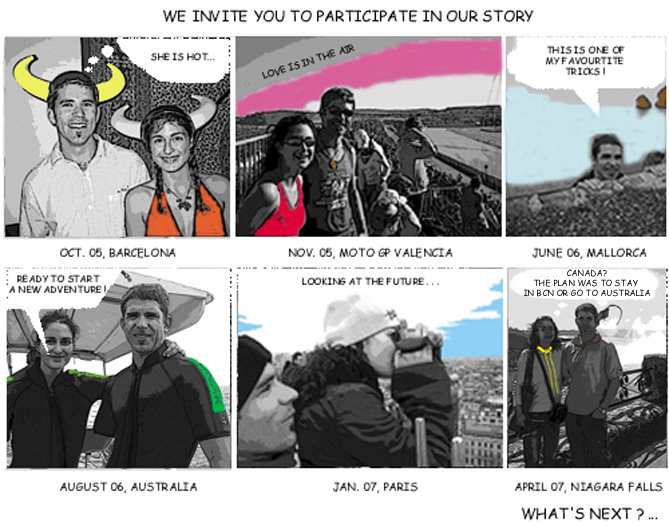
We would like to give special thanks to all our friends and family who have supported us in many ways during the evolution of our relationship.
We also would like to thank you all family and friends that are coming from abroad. It's a long trip, so we are very happy that you can make it.
And finally, we cannot miss to mention Leandro and Inés, our friends that introduced us.
Subscriure's a:
Comentaris (Atom)